Chapter 2 Home Next Chapter Previous Chapter
Chapter 2  
 

We will begin our study of physics with a study of motion. 

Look around you, and you will find that almost everything is in motion: flying birds, running people, falling books, etc. We will analyze their motions and think about how fast the object moves and how far. 

 
1. Distance and Displacement
2. Average Velocity and Instantaneous Velocity
3. Position-time Graph
4. Velocity-time Graph
5. Relative Motion
6. Chapter 2 Quiz
  Section

Check!

Section 1. Distance and Displacement

Distance and displacement are different. When you traveled 50 km to the East and then 20 km to the West, the total distance you traveled is 70 km, but your displacement is 30 km East. 

A picture explaining distance and displacement

In physics, we say that distance is a scalar and displacement is a vector. Scalar has a magnitude and vector has both a magnitude and a direction. Scalar is one dimensional and vector is two dimensional. 


QUESTION: A car moved 50 km to the North. What is its displacement? 
(e.g. "10 km East") 

QUESTION: A car moved 20 km East and 70 km West. What is the distance?
km 


  Section Section 2. Average Velocity and Instantaneous Velocity

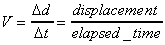
Velocity shows how fast an object is moving in which direction. Average velocity can be calculated by dividing displacement over time. 

 
Check!
Formula for Velocity

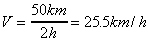
For example, when a car moved 50 km in 2 hours, the average velocity is 25 km/h because 50 km divided by 2 h
The instantaneous velocity shows the velocity of an object at one point. For example, when you are driving a car and its speedometer swings to 90 km/h, then the instantaneous velocity of the car is 90 km/h. 


QUESTION: How far will a car travel in 15 min at 20 m/s?
km 


  Section

Check!

Section 3. Position-time Graph

A position-time graph simply shows the relationship between time and position. From the following data, for example, 
 
time (s) 1 2 3 4 5
position (m) 0 20  50 130 150  200

You can draw the following graph: 

A position-time graph

The tangent of a position-time graph represents velocity since 

Formula to get velocity from a position-time graph


QUESTION: Answer the questions using the previous graph: 

What is the average velocity during the first 2 seconds? 
m/s 

What is the average velocity of the whole trip? 
m/s 


  Section

Check!

Section 4. Velocity-time Graph

A velocity-time graph shows the relationship between velocity and time. For example, if a car moves at constant velocity of 5 m/s for 10 seconds, you can draw a velocity-time graph that looks like this: 

A velocity-time graph

The area below the line represents the displacement the object traveled since it can be calculated by x * y, or (time * velocity) which equals to displacement. 


QUESTION: Calculate the distance traveled by the car. 


  Section Section 5. Relative Motion

When car A moves at 50 km/h and car B moves at 30 km/h in opposite direction, the velocity of car A relative to car B is 80 km/h. 


QUESTION: If you are walking at a constant velocity of 5 km/h and a car passed you by at the speed of 20 km/h from behind, what is the car's velocity from your viewpoint? 
km/h 

QUESTION: If you are running at constant velocity of 5 m/s, what is your relative velocity to Earth? 
m/s 


  Section Section 6: Chapter 2 Quiz

Take the Chapter 2 Quiz to see how well you can do!


[Home] - [Ch1] - [Ch2] - [Ch3]